
From the source material
1 / 3
Image from OpenAI.
2 / 3
Image from OpenAI.
3 / 3
Image from OpenAI.
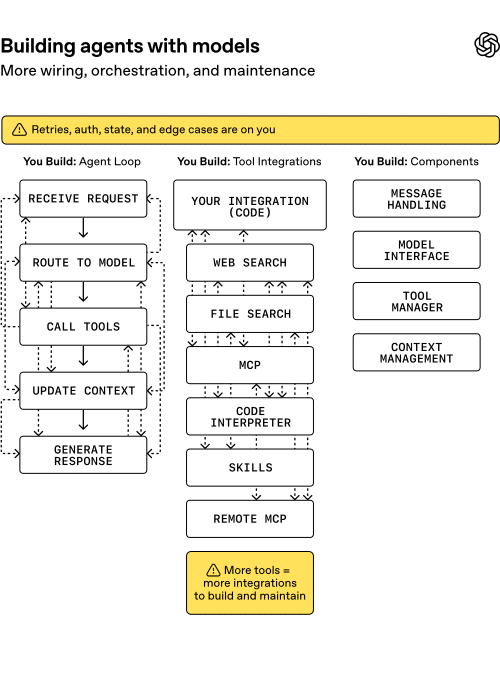
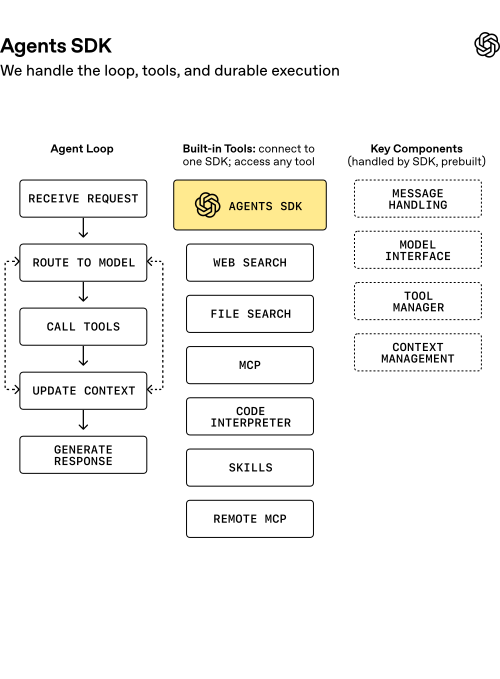
OpenAI's latest tools aren't going to make for flashy stage demos, and that is excellent news. Production agents don't need confetti; they need harnesses. OpenAI's Agents SDK update introduces a model-native framework designed to let agents work across files and tools safely. By building in native sandbox execution, configurable memory, workspace manifests, and Codex-like filesystem tools, OpenAI is acknowledging that a naive agent with shell access is just a liability waiting to happen.
Useful agents have to inspect files, execute commands, and use tools. But giving a model hands without a controlled environment is how 'fix this bug' turns into 'why is the production database gone?' OpenAI specifically mentions support for controlled computer environments and integrations with sandbox providers like E2B, Modal, and Vercel. Where an agent runs, and what data it's allowed to touch, isn't an implementation detail—it is the entire product.
Builders need to test the harness as rigorously as the model itself. Force a command failure. Check what secrets the agent can see. Review how it stores outputs. If OpenAI's SDK makes the secure path the path of least resistance, it will win massive adoption. But if teams still have to bolt their own safety controls onto a fragile AI workflow, the agent stack remains an artisanal craft project. The future of agentic AI isn't boundless autonomy; it's extremely robust scaffolding.
In short
With native sandboxes, filesystem tools, and workspace manifests, OpenAI is admitting that agents need unglamorous harnesses to keep them from becoming clever incident generators.
Keep the signal coming
Useful AI, fewer talking points.
Follow Useful Machines for practical AI news, workflows, tools, and strategy. Sponsors can also evaluate whether this article belongs in the practical ai readers lane.